Cognitive Shuffle
A technique from sleep researcher Luc Beaudoin that silences racing thoughts by flooding your mind with random, unconnected images. Your brain interprets this randomness as a signal that it's safe to sleep.
Developed by Luc Beaudoin, cognitive scientist at Simon Fraser University, based on his research into cognitive mechanisms of sleep onset. The technique leverages the observation that pre-sleep cognition naturally shifts from logical/sequential to random/associative as the brain transitions toward sleep. Published in Beaudoin (2013), Cognitive Productivity.
Overview
Your brain has two modes of thinking. The first is logical, verbal, sequential — the mode you use all day. The second is random, visual, associative — the mode your brain shifts to right before sleep. Insomnia happens when the first mode won't hand off to the second. The Cognitive Shuffle forces the handoff by giving your logical mind a task that produces random, meaningless images. Your brain reads this output pattern and concludes: "This looks like sleep onset. Time to shut down."
Steps
1. Choose a Starting Word
Duration: 15 seconds
Think of any concrete, emotionally neutral word with at least 5 letters. "GARDEN" works. "TABLE" works. "BLANKET" works. Avoid words connected to your worries. Don't use "DEADLINE" if work stress is keeping you up. The word is just a seed. It doesn't matter what it is as long as you can spell it.
2. Take the First Letter
Duration: 15 seconds
Take the first letter of your word. If your word is "GARDEN," your first letter is G. You're going to think of objects — concrete, visible things — that start with G. Not concepts. Not feelings. Things you can see and picture.
3. Generate Random Images — First Letter
Duration: 120 seconds
For each object you think of, hold a brief mental image of it for 2-3 seconds. Don't describe it in words. Just see it. G: A green grape. See it. A guitar leaning against a wall. See it. A glass of water on a table. See it. A goat standing in a field. See it. Keep going until you can't easily think of more G-words, then move to the next letter. Speed doesn't matter. Boredom is actually the goal. These images should be mundane, not vivid or exciting.
4. Move Through the Letters
Duration: 300 seconds
Take the next letter — A. Apple. Airplane. Armchair. Anchor. See each one briefly, then let it dissolve. Move to R. Rainbow. Refrigerator. Rope. Rock. Continue through each letter of your starting word. If a letter is difficult (few common words), spend 15 seconds trying, then skip it. If a word triggers an emotional reaction or a chain of thoughts, drop it immediately and picture the next random object. The technique works because the images are disconnected. Connection is wakefulness. Randomness is sleep.
5. Keep Going or Let Sleep Take Over
Duration: 120 seconds
Most people fall asleep before finishing their starting word. If you make it through all the letters, pick a new word and start again. Or abandon the structure entirely and just picture random, unconnected objects every 2-3 seconds. A bicycle. A lamp. A sandwich. A cloud. A key. Notice: the images might start becoming stranger, more dreamlike, less controlled. Colors might shift. Shapes might distort. That's hypnagogia — the transition phase between waking and sleep. You're right at the edge. Stop trying. Let go.
Why practice this
Benefits
- Blocks rumination by occupying the mind's verbal processing center
- Mimics the random imagery of sleep onset (hypnagogia), tricking the brain into sleep mode
- Works within 5-10 minutes for most people on first attempt
- Requires no special skills, equipment, or preparation
- Particularly effective for overthinkers and analytical minds
- Can be restarted mid-night if you wake up and can't fall back asleep

Research
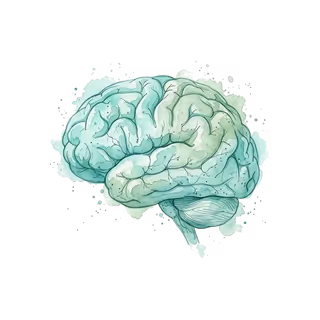
Developed by Luc Beaudoin, cognitive scientist at Simon Fraser University, based on his research into cognitive mechanisms of sleep onset. The technique leverages the observation that pre-sleep cognition naturally shifts from logical/sequential to random/associative as the brain transitions toward sleep. Published in Beaudoin (2013), Cognitive Productivity.
Science
Sleep onset is characterized by a shift from sequential, logical cognition (associated with prefrontal cortex activity) to random, associative pattern generation (associated with the default mode network in a deactivated state). Beaudoin's insight was that deliberately generating random, unconnected mental images mimics the cognitive signature of this transition, effectively telling the brain's sleep-monitoring systems that the transition has already begun. The brain responds by reducing prefrontal activity and increasing theta wave production — the neurological precursor to Stage 1 sleep. The technique is also effective because it occupies the inner monologue (verbal working memory) with a benign task, preventing it from engaging in the rumination loops that sustain insomnia.
Preparation
What You Need
- Your bed, lights off
- A starting word (any concrete noun will work)
- Nothing else — this technique is entirely mental
Pro tips
Tips for Success
- 1Use a different starting word each night. Novelty keeps the technique fresh.
- 2If a word triggers an emotional response or a train of thought, drop it immediately and move to the next letter
- 3The images should be boring, everyday objects. A red ball. A wooden chair. A leaf. Nothing exciting.
- 4Don't try to connect the images into a story. Randomness is the active ingredient.
- 5If you hit a hard letter (X, Q, Z), skip it. Don't waste mental energy on difficulty.

Ready to Start?
Take 10 minutes today. Follow the steps above and begin building your practice.
Explore More Practices