Tai Chi Basics
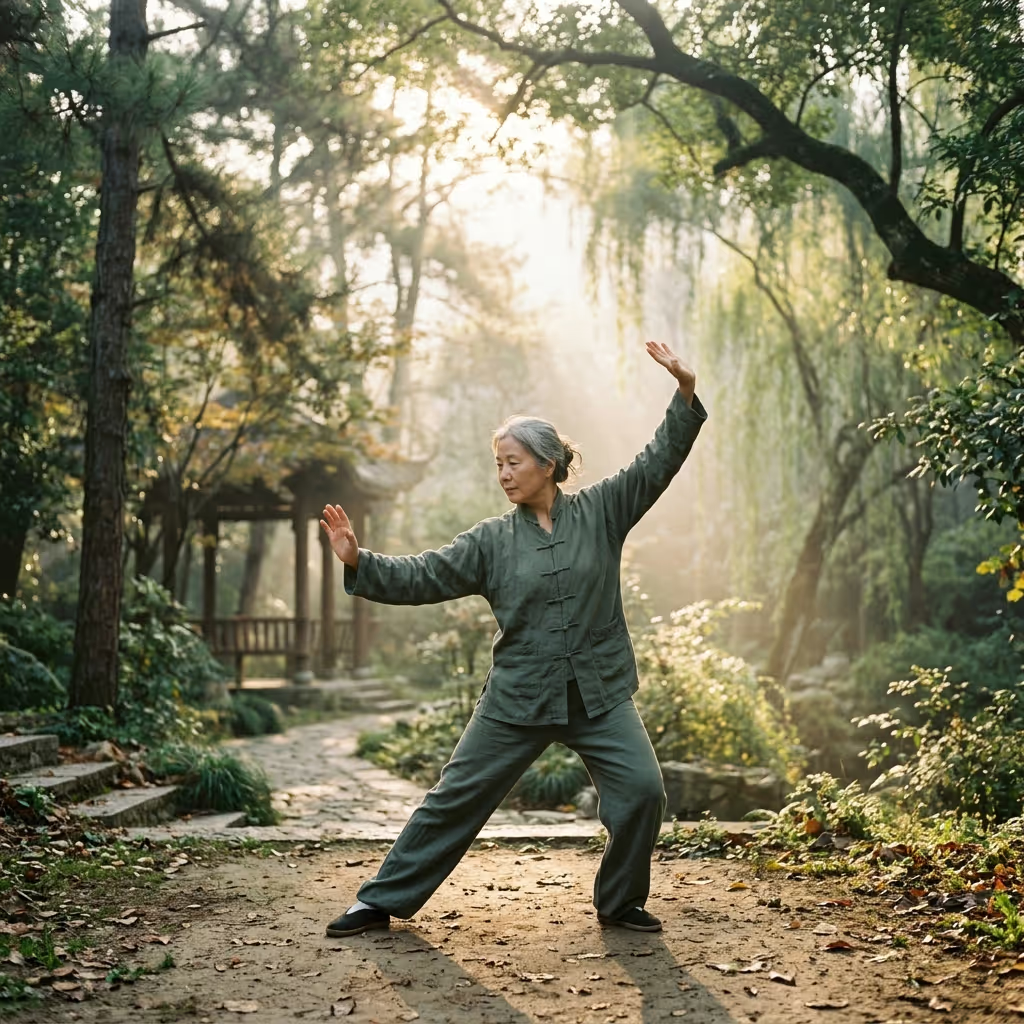
Five foundational Tai Chi movements that coordinate breath with slow, deliberate motion. A moving meditation that builds balance, reduces fall risk, and calms a restless mind.
Li et al. (2019) in JAMA Internal Medicine showed 43% fall reduction in a large RCT. Yeh et al. (2008) in the Journal of the American College of Cardiology demonstrated blood pressure improvements. Wang et al. (2014) published a comprehensive systematic review in BMC Complementary and Alternative Medicine confirming benefits for anxiety, depression, and balance.
Overview
Tai Chi looks effortless when someone experienced does it. It isn't. Controlling your body in slow motion requires more muscular engagement and mental focus than most fast exercises. These five basic movements are the building blocks of every Tai Chi form. They teach you to coordinate breath with motion, shift your weight smoothly, and maintain a low, stable center of gravity. You'll feel the difference in your balance and mental clarity within two weeks.
Steps
1. Wu Ji — Standing Meditation
Duration: 120 seconds
Stand with feet shoulder-width apart. Bend your knees slightly — enough that you couldn't lock them if you tried. Let your arms hang at your sides, hands relaxed with a gentle curve as if holding two small balls. Tuck your chin slightly so the crown of your head points toward the ceiling. Imagine a string pulling you up from the top of your head while your weight sinks down through your feet into the ground. This dual direction — up and down simultaneously — is the foundation of all Tai Chi. Breathe naturally. Hold for 2 minutes.
2. Lifting and Lowering Arms
Duration: 120 seconds
From Wu Ji, inhale and slowly raise both arms in front of you to shoulder height, palms facing down. The motion should take the full length of your inhale — about 4 seconds. Your shoulders stay down. Your elbows stay slightly bent. Now exhale and slowly lower your arms back to your sides. Again, the full length of your exhale. This is harder than it sounds. Most people rush. Slow the movement until it matches your breath exactly. Repeat 6 times. Your arms may feel heavy. That heaviness is the point.
3. Weight Shifting
Duration: 150 seconds
Start in Wu Ji. Slowly shift your weight to your right foot. Your left foot stays on the ground but carries almost no weight — you could lift it easily. Hold for a breath. Now shift to your left foot. Same thing. Right foot stays down but carries nothing. Move back and forth, taking 3-4 seconds per shift. Keep your hips level. Most people tip their hips to the side — check a mirror if possible. This teaches your body to load one leg fully before stepping, which is why Tai Chi practitioners rarely stumble.
4. Part the Wild Horse's Mane
Duration: 180 seconds
Your right foot is forward, left foot back, about shoulder-width apart at a diagonal. Both knees bent. Hold an imaginary ball — right hand on top, left hand underneath. Shift your weight forward onto your right foot while your right arm sweeps up and out at chest height (palm up) and your left hand presses down beside your left hip (palm down). The arms move together but in opposite directions. Step forward with your left foot and reverse — left hand rises, right hand lowers. Repeat this stepping pattern 3 times each side. Every movement synchronized with your breath. Inhale as you gather the ball. Exhale as you step and separate your hands.
5. Cloud Hands
Duration: 180 seconds
Stand with feet slightly wider than shoulder-width, knees bent. Your left hand is at waist height, palm up. Your right hand is at face height, palm facing you. Shift your weight to your right foot while your right hand sweeps horizontally to the right and your left hand rises. Think of your hands slowly orbiting around each other, like planets. As your weight shifts left, your left hand sweeps to the left at face height while your right hand descends. The movement is circular and continuous — no pausing, no stopping, no hard edges. Let your hips rotate naturally with the weight shift. This is the signature Tai Chi movement. Five repetitions each direction.
6. Closing Form
Duration: 90 seconds
Return to Wu Ji. Inhale and raise both arms to shoulder height one final time. Exhale and lower them with deliberate slowness, pressing your palms gently downward as if smoothing water. Imagine drawing calm energy from the crown of your head down through your body and into the ground. Stand still for 30 seconds with your eyes closed. Notice your heartbeat, your breath, the sensation in your legs. You've been standing for 15 minutes in controlled slow motion. That quiet aliveness you feel is Tai Chi's effect.
Why practice this
Benefits
- Reduces fall risk by 43% in older adults (Li et al., 2019, JAMA Internal Medicine)
- Lowers blood pressure comparable to moderate-intensity exercise (Yeh et al., 2008)
- Improves balance and proprioception measurably within 8 weeks
- Reduces anxiety and depression symptoms (Wang et al., 2014)
- Increases lower body strength without impact stress
- Improves cognitive function and working memory in adults over 50
Research
Li et al. (2019) in JAMA Internal Medicine showed 43% fall reduction in a large RCT. Yeh et al. (2008) in the Journal of the American College of Cardiology demonstrated blood pressure improvements. Wang et al. (2014) published a comprehensive systematic review in BMC Complementary and Alternative Medicine confirming benefits for anxiety, depression, and balance.
Science
Tai Chi's slow, controlled movements challenge the vestibular system, proprioceptive feedback loops, and postural muscles simultaneously — a combination that strengthens balance more effectively than static balance exercises. Li et al. (2019) demonstrated a 43% reduction in falls among older adults in a randomized trial of 670 participants. The practice also activates the parasympathetic nervous system through its emphasis on diaphragmatic breathing, leading to measurable reductions in cortisol and blood pressure.
Preparation
What You Need
- Flat, non-slip surface with enough room to step in each direction
- Comfortable shoes or bare feet
- Loose clothing that doesn't restrict arm movement
- 15 minutes of uninterrupted time
Pro tips
Tips for Success
- 1Slower is harder and more beneficial. If it feels too easy, slow down.
- 2Keep your knees slightly bent at all times. Locked knees break the energy flow.
- 3Your weight should feel like it's sinking into the ground, not floating upward
- 4Focus on smooth transitions between movements, not the positions themselves
- 5Practice facing a window or outdoors when possible. Visual horizon helps balance.
Ready to Start?
Take 15 minutes today. Follow the steps above and begin building your practice.
Explore More Practices