Gentle Yoga Flow
Eight simple poses linked by your breath into a flowing sequence. No flexibility or experience required. Twenty minutes to release tension and reconnect with your body.
Pascoe and Bauer (2015) systematic review of 25 RCTs published in Psychoneuroendocrinology confirmed yoga reduces cortisol and improves stress biomarkers. Saper et al. (2017) in Annals of Internal Medicine found yoga as effective as physical therapy for chronic low back pain.
Overview
This flow connects eight foundational yoga poses with slow, intentional breathing. Each pose targets a different area of tension that desk work, stress, and daily life create. You don't need to be flexible. You don't need experience. The only requirement is that you move at the pace of your own breath and respect what your body tells you.
Steps
1. Mountain Pose and Centering
Duration: 90 seconds
Stand with your feet hip-width apart. Not together — hip-width. Most people stand too narrow. Let your arms hang. Close your eyes. Rock forward onto the balls of your feet, then back onto your heels. Find the center where your weight distributes evenly. Stack your hips over your ankles, your shoulders over your hips, your ears over your shoulders. Take five slow breaths. You're setting a baseline for your body's alignment.
2. Standing Forward Fold
Duration: 120 seconds
On an exhale, hinge at your hips (not your waist — there's a difference) and fold forward. Bend your knees as much as you need to. Grab opposite elbows and let your head hang heavy. Your neck should be completely relaxed — nod "yes" and shake "no" to check. This inverts your relationship with gravity and decompresses your lower spine. Hold for 5 breaths. Each exhale, let gravity pull you a little deeper. Don't force it.
3. Tabletop to Cat-Cow
Duration: 150 seconds
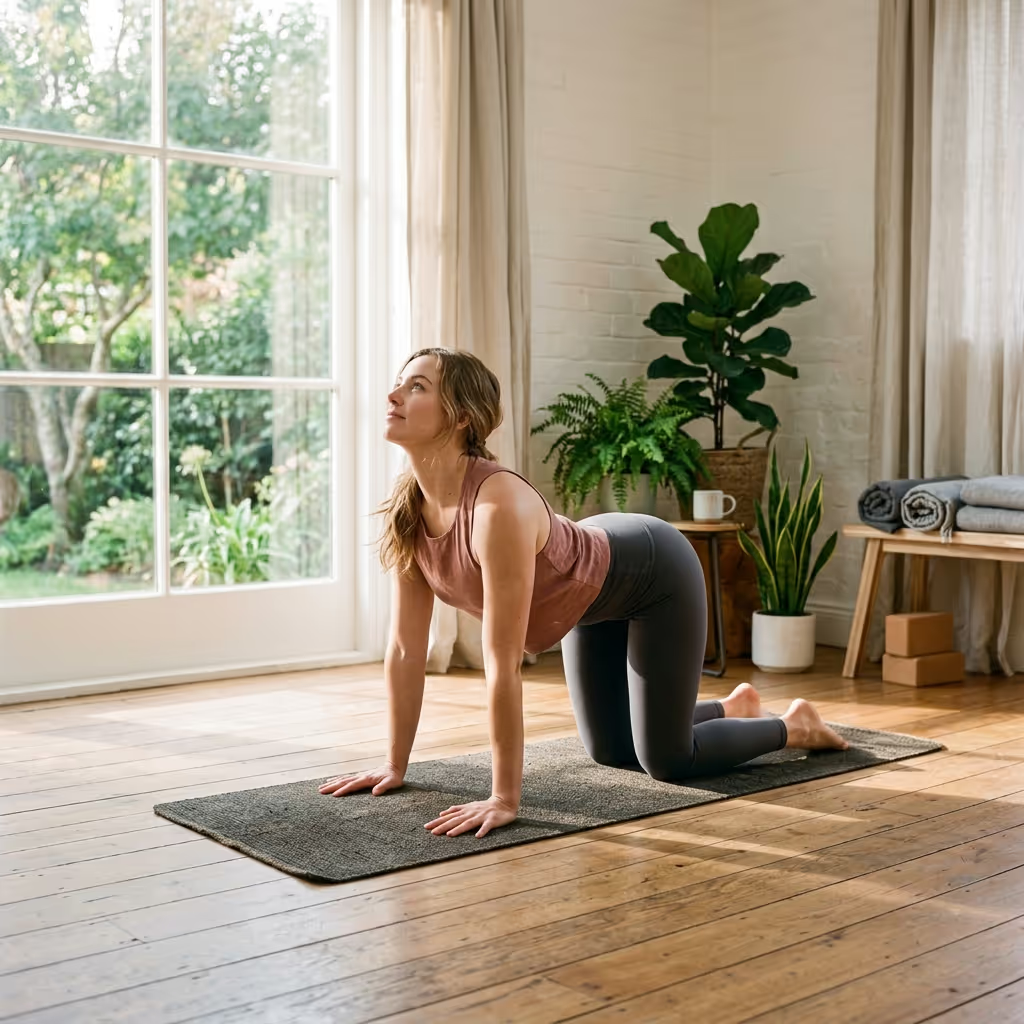
Lower yourself to hands and knees. Hands directly under shoulders, knees under hips. Spread your fingers wide — this protects your wrists. On your inhale, drop your belly toward the floor, lift your chest and tailbone (Cow). On your exhale, round your spine toward the ceiling, tuck your chin, press the floor away (Cat). Move slowly. Your spine has natural curves that get compressed during the day. This restores them. Repeat 8-10 cycles.
4. Downward Facing Dog
Duration: 120 seconds
From tabletop, tuck your toes, lift your hips up and back. Your body forms an inverted V. Your heels don't need to touch the ground. Bend your knees generously. The priority is a long, straight spine — not straight legs. Press firmly through your hands. Let your head hang between your arms. Pedal your feet — bending one knee, then the other — to loosen your calves and hamstrings. Hold for 5 breaths.
5. Low Lunge
Duration: 120 seconds
From Downward Dog, step your right foot forward between your hands. Lower your left knee to the mat. Untuck your left toes. Your right knee should be directly over your right ankle — not pushing past your toes. Sink your hips forward and down. You'll feel a deep stretch in the front of your left hip. This is your hip flexor. It shortens every hour you sit. Hold for 5 breaths. Switch sides.
6. Seated Twist
Duration: 120 seconds
Sit on the floor with legs extended. Bend your right knee and place your right foot outside your left thigh. Inhale and lengthen your spine tall. Exhale and twist to the right, placing your left elbow outside your right knee. Each inhale, grow taller. Each exhale, rotate slightly deeper. Never force the twist. Your spine should feel like it's wringing out — gently, like a wet towel. Hold for 5 breaths. Switch sides.
7. Supine Figure Four
Duration: 120 seconds
Lie on your back. Cross your right ankle over your left thigh, just above the knee. Thread your hands behind your left thigh and gently pull it toward your chest. You'll feel a deep stretch in your right outer hip and glute. This is where stress accumulates from sitting. If you can't reach your thigh, loop a towel or belt behind it. Keep your head on the floor. Hold for 5 breaths per side.
8. Savasana
Duration: 120 seconds
Lie flat on your back. Legs extended, feet falling open naturally. Arms at your sides, palms up. Close your eyes. Do nothing. Resist the urge to fidget, check the time, or plan your next task. Your body is integrating the work you just did. Your nervous system is shifting into recovery mode. Stay here for at least 2 minutes. When you're ready, roll to your right side, pause, then slowly press up to sitting.
Why practice this
Benefits
- Reduces perceived stress by 31% over 10 weeks (Pascoe & Bauer, 2015)
- Increases flexibility and joint range of motion within 2-4 weeks
- Lowers resting cortisol and improves heart rate variability
- Reduces chronic low back pain as effectively as physical therapy (Saper et al., 2017)
- Improves balance and proprioception
- Decreases symptoms of anxiety and mild depression
Research
Pascoe and Bauer (2015) systematic review of 25 RCTs published in Psychoneuroendocrinology confirmed yoga reduces cortisol and improves stress biomarkers. Saper et al. (2017) in Annals of Internal Medicine found yoga as effective as physical therapy for chronic low back pain.
Science
Yoga's combination of stretching, breathing, and mindful awareness activates the parasympathetic nervous system while simultaneously reducing cortisol and inflammatory markers. Pascoe and Bauer's 2015 review demonstrated consistent cortisol reduction across multiple studies. The slow, controlled movements also stimulate proprioceptors in joints and muscles, improving body awareness, which research links to reduced anxiety and better emotional regulation.
Preparation
What You Need
- A yoga mat or carpeted floor
- Comfortable clothing that allows full range of motion
- 20 minutes without interruption
- Optional: yoga block or thick book for support
- Optional: blanket for final relaxation
Pro tips
Tips for Success
- 1Never push into pain. Discomfort is fine. Sharp or shooting pain means stop.
- 2Your breath sets the pace, not some ideal version of the pose
- 3If a pose feels wrong for your body, skip it. There is no mandatory sequence.
- 4Practice barefoot — your feet need sensory contact with the ground
- 5Don't compare yourself to photos or videos. Your version of each pose is the right version.
Ready to Start?
Take 20 minutes today. Follow the steps above and begin building your practice.
Explore More Practices