Walking Meditation
Mindfulness in motion. You walk slowly, deliberately, paying attention to every phase of each step. Ideal for people who find sitting still unbearable — the movement gives restless minds something physical to anchor to.
Teut et al. (2013) in Evidence-Based Complementary and Alternative Medicine showed walking meditation reduced psychological distress comparably to traditional meditation. Thich Nhat Hanh popularized the practice in Western mindfulness. Research on kinesthetic meditation suggests movement-based practices are particularly effective for people who struggle with stillness-based approaches.
Overview
Walking meditation takes something you do every day — walking — and transforms it into a mindfulness practice by slowing it down until each component becomes visible. Lifting, moving, placing. You probably take 5,000-10,000 steps daily without feeling a single one. This practice asks you to feel 200 of them. The slow pace forces your brain into present-moment awareness because there's nothing else to do. No destination. No deadline. Just this step, then the next one.
Steps
1. Stand and Ground
Duration: 90 seconds
Stand at one end of your walking path. Feet hip-width apart. Arms relaxed at your sides or hands clasped gently in front of your body. Close your eyes briefly. Feel the ground beneath your feet — the temperature, the texture, the pressure. Notice your weight distributed between both feet. Feel gravity pulling you down while your spine holds you up. Open your eyes. Lower your gaze to a spot on the ground about six feet ahead. Take three breaths.
2. Lift, Move, Place — First Steps
Duration: 180 seconds
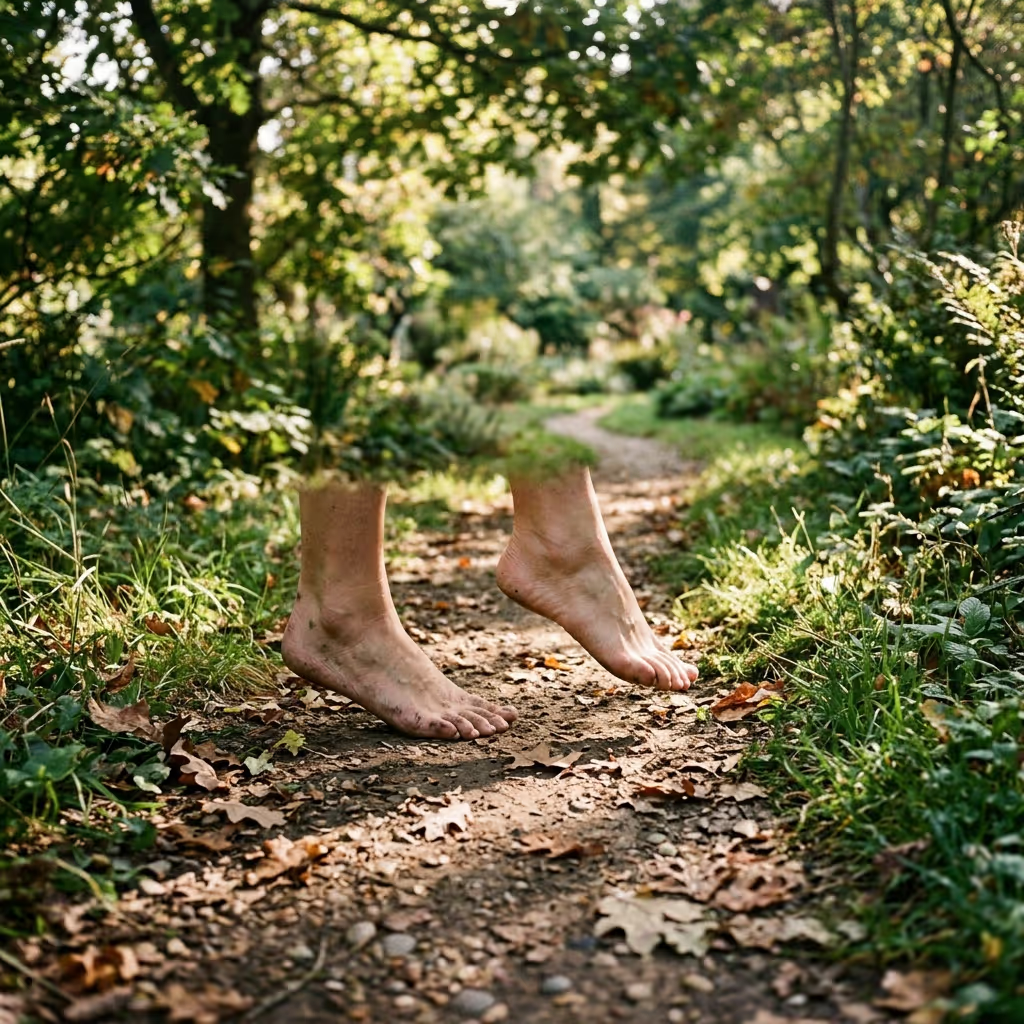
Begin to walk. Absurdly slowly. Lift your right foot. Feel the weight shift entirely to your left leg. Notice your right heel leave the ground, then the ball of your foot, then your toes. The foot hangs in air for a moment. Move it forward. Feel it lower — heel contacts ground first, then the ball, then the toes spread. Weight transfers. One step complete. Now the left foot. Lift. Move. Place. Each step should take 3-4 seconds. If it doesn't feel uncomfortably slow, slow down more.
3. Build a Rhythm
Duration: 240 seconds
Continue walking at this pace. You'll find a natural rhythm. Lift. Move. Place. Lift. Move. Place. Your mind will wander. You'll suddenly realize you've been thinking about something and walking on autopilot. When you notice, stop. Stand. Take one breath. Resume walking with attention. Each return to awareness is a successful repetition. Some practitioners silently label each phase: "lifting... moving... placing..." The labeling gives the verbal mind a job so it doesn't wander as much.
4. Turn at the End
Duration: 60 seconds
When you reach the end of your path, stop. Stand still. Feel both feet on the ground. Notice any urge to immediately turn around and keep going — that's momentum, and it's worth pausing for. Then slowly — very slowly — turn around. Notice the weight shifting as you rotate. Notice your feet adjusting. Face the other direction. Pause again. One breath. Begin walking back. The turn is part of the practice, not an interruption.
5. Add Breath Awareness
Duration: 240 seconds
Now coordinate your steps with your breathing. Inhale for two or three steps. Exhale for two or three steps. Find a ratio that feels natural — don't force a pattern that doesn't match your pace. Let breath and movement merge into one flowing experience. Breathing and walking — the two most basic human activities — happening together with full awareness. If your mind wanders, return to the feet. Always the feet.
6. Return to Stillness
Duration: 90 seconds
As the practice draws to a close, gradually slow your pace even further. Take your last few steps as slowly as you can manage. Then stop. Stand still. Both feet planted. Feel your body now — perhaps more grounded, more present, more connected to the physical world than when you started. Your legs may feel alive, warm, tingling. Take three deep breaths. Open your awareness from your feet to the full room around you. Walk away at normal speed, carrying whatever piece of this attention you can into the rest of your day.
Why practice this
Benefits
- As effective as sitting meditation for reducing anxiety (Teut et al., 2013)
- More accessible for people with ADHD, restlessness, or chronic pain from sitting
- Combines light physical exercise with mindfulness training
- Reduces agitation and nervous energy through grounding movement
- Improves proprioception and body awareness
- Can be practiced anywhere — indoors, outdoors, in a hallway

Research
Teut et al. (2013) in Evidence-Based Complementary and Alternative Medicine showed walking meditation reduced psychological distress comparably to traditional meditation. Thich Nhat Hanh popularized the practice in Western mindfulness. Research on kinesthetic meditation suggests movement-based practices are particularly effective for people who struggle with stillness-based approaches.
Science
Walking meditation engages the cerebellum (balance and coordination), motor cortex, and somatosensory cortex simultaneously while also activating the attention networks used in seated meditation. This multi-system engagement gives the brain more anchor points than breath alone, making it easier for people with hyperactive minds to maintain focus. The vestibular challenge of slow walking also increases proprioceptive input, which has been shown to reduce anxiety through the same grounding mechanism that makes standing on solid ground feel safer than standing on a boat.
Preparation
What You Need
- A straight path of 10-30 steps (hallway, garden path, sidewalk)
- Comfortable shoes or bare feet
- 15 minutes
- A space where you won't feel self-conscious about walking strangely slowly
Pro tips
Tips for Success
- 1Start much slower than feels natural. If it doesn't feel weird, you're probably moving too fast.
- 2Practice somewhere private the first few times. Walking at snail pace looks odd, and self-consciousness kills focus.
- 3Bare feet on natural surfaces (grass, sand, wood floor) adds a layer of sensory input that deepens the practice
- 4If 15 minutes feels long, start with 5 minutes and build up
- 5This is the best meditation for days when sitting still feels impossible

Ready to Start?
Take 15 minutes today. Follow the steps above and begin building your practice.
Explore More Practices