Body Scan Meditation
A systematic scan from feet to head that reveals where you carry tension and teaches your body to release it. Fifteen minutes of focused attention that most people find more restful than a nap.
Core practice in Mindfulness-Based Stress Reduction (MBSR), developed by Kabat-Zinn (2013). Kabat-Zinn et al. (1985) published the first clinical study in the Journal of Behavioral Medicine showing significant pain reduction. Ditto et al. (2006) in Psychosomatic Medicine demonstrated that body scanning reduces blood pressure and cortisol more effectively than progressive muscle relaxation.
Overview
A body scan is the simplest way to reconnect with your physical self after a day spent living in your head. You lie down, close your eyes, and move your attention through your body one section at a time — not visualizing, not imagining, just noticing what's actually there. Tightness, warmth, numbness, tingling, heaviness, nothing. Whatever you find is the right answer. The scan itself creates a cascade of relaxation responses that accumulate over the 15-minute practice.
Steps
1. Lie Down and Settle
Duration: 60 seconds
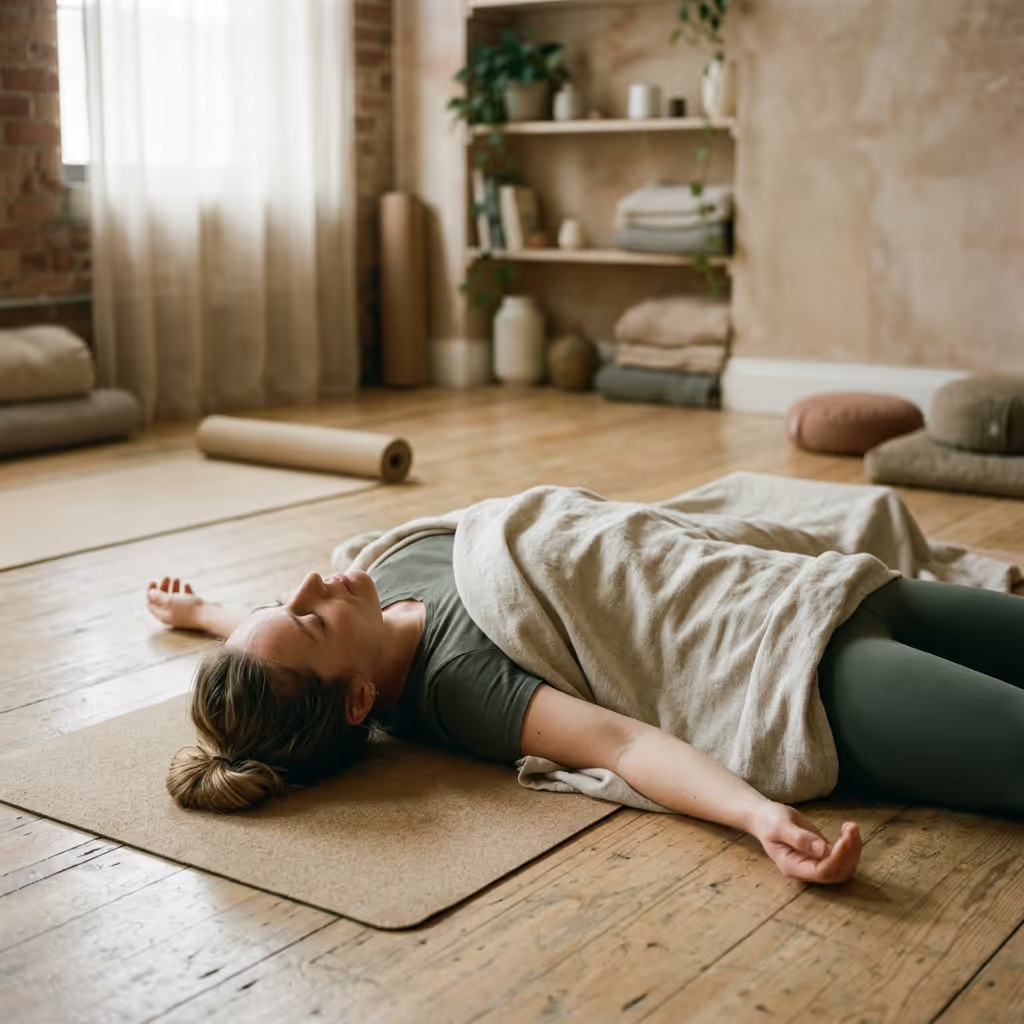
Lie on your back. Legs extended, feet falling naturally apart. Arms at your sides, palms facing up. If your lower back complains, bend your knees or put a pillow beneath them. Cover yourself with a blanket — your body temperature will drop as you relax. Close your eyes. Take three deep breaths, each exhale deliberately long and slow. Feel the weight of your body pressing into the surface beneath you. You're here. Nothing else needs your attention right now.
2. Feet
Duration: 120 seconds
Bring your full attention to your feet. Start with your toes. Can you feel each one individually, or do they blur together? Notice the temperature — are they warm or cool? Feel the bottoms of your feet, the arches, the heels. Notice whether there's any tension. Most people grip their toes unconsciously. If yours are clenched right now, let them release. Breathe into your feet. Not metaphorically — direct your exhale toward them and notice what happens. Spend a full 30 seconds here before moving on.
3. Lower Legs and Knees
Duration: 90 seconds
Shift your attention to your calves. These muscles absorb impact all day — walking, standing, climbing stairs. Feel them resting now. Notice any soreness, tightness, or warmth. Move to your shins, ankles, and then your knees. Knees are complex joints that rarely get conscious attention. Feel both knees. Are they the same? One might feel different from the other. Just observe. No fixing needed.
4. Thighs, Hips, and Pelvis
Duration: 120 seconds
Your thighs are the largest muscles in your body. When they release, you feel it as a heavy sinking sensation — your legs getting noticeably heavier. Let that happen. Move to your hips. If you sit for work, your hip flexors are shortened and tight right now. You may not feel the tightness until you bring attention to it. Let your hips widen. Feel your pelvis heavy on the floor. Your lower back may settle and flatten slightly. That's stored tension leaving.
5. Belly, Lower Back, and Chest
Duration: 120 seconds
Notice your belly. Unlike almost every other moment of your day, you don't need to hold it in. Let it be soft. Feel it rise with each inhale and fall with each exhale. Your diaphragm is doing work it can't do when your abs are braced. Move to your lower back. Is there a gap between your back and the floor? Let it close. Let gravity have your spine. Continue to your chest and rib cage. Feel the expansion and contraction of each breath. Your breathing may have slowed by now. Let it be whatever pace it chooses.
6. Hands, Arms, and Shoulders
Duration: 120 seconds
Bring your attention to your fingertips. Can you feel your pulse in them? Some people can, especially in a quiet room. Move through your palms, wrists, forearms, elbows, upper arms. Let each segment go heavy. Your shoulders are next. They've been carrying something — metaphorically and literally — all day. They're almost certainly higher and tenser than they need to be right now. Let them drop. Let them fall toward the floor. Feel the distance between your shoulders and your ears increase.
7. Neck, Jaw, and Face
Duration: 120 seconds
Your neck supports a 10-12 pound head all day. Feel it resting now, fully supported by the floor. Let it be heavy. Move to your jaw. Are your teeth touching? They shouldn't be. Let your jaw drop so your teeth separate slightly. Let your tongue rest at the bottom of your mouth, away from the roof. Soften the muscles around your eyes. Unclench your forehead — you're probably furrowing it right now without knowing. Let every muscle in your face go slack. A fully relaxed face feels strange because you almost never experience it.
8. Whole Body and Close
Duration: 120 seconds
Expand your attention to your entire body at once. Feel yourself as one continuous, breathing form. Heavy. Warm. Connected. The individual parts dissolve into a whole. Lie here for 30 seconds in this state of unified awareness. Then begin to return: wiggle your fingers, wiggle your toes. Gently bend your knees. Roll to one side and pause. Press yourself up to sitting slowly. Open your eyes. Move carefully — you've been deeply relaxed. Standing up quickly may make you lightheaded.
Why practice this
Benefits
- Reduces chronic pain perception by 40-57% in MBSR studies (Kabat-Zinn et al., 1985)
- Improves sleep quality by lowering pre-sleep physiological arousal
- Reduces cortisol levels by 15-25% per session
- Increases interoceptive awareness — the ability to read your body's signals
- Releases muscle tension you didn't know you were holding
- Serves as a gateway practice for people who find breath meditation too abstract
Research
Core practice in Mindfulness-Based Stress Reduction (MBSR), developed by Kabat-Zinn (2013). Kabat-Zinn et al. (1985) published the first clinical study in the Journal of Behavioral Medicine showing significant pain reduction. Ditto et al. (2006) in Psychosomatic Medicine demonstrated that body scanning reduces blood pressure and cortisol more effectively than progressive muscle relaxation.
Science
Body scanning works through a mechanism called interoceptive attention — directing awareness inward to detect signals from within the body. This activates the insular cortex, a brain region that maps internal body states and integrates them with emotional processing. When you strengthen this pathway, you become better at detecting early signs of stress, hunger, fatigue, and emotional states before they escalate. Ditto et al. (2006) demonstrated that body scanning reduces blood pressure and cortisol more effectively than cognitive relaxation techniques, suggesting that the body-focused approach engages the parasympathetic nervous system more directly.
Preparation
What You Need
- A yoga mat, carpet, or bed to lie on
- A blanket (your temperature drops during relaxation)
- A pillow under your knees if your lower back is sensitive
- 15 minutes without interruption
- Optional: eye mask to block visual distraction
Pro tips
Tips for Success
- 1If you fall asleep, that's your body telling you something. But if your goal is awareness rather than sleep, try the scan seated or with eyes open.
- 2Don't try to relax. Trying to relax creates tension. Just observe what's there. Relaxation is a side effect of observation.
- 3If you can't feel anything in a body part, that's data, not failure. Report "nothing" to yourself and move on.
- 4Your jaw, shoulders, and hip flexors are the three areas where most people find the most hidden tension. Pay extra attention there.

Ready to Start?
Take 15 minutes today. Follow the steps above and begin building your practice.
Explore More Practices